
From Aid to Solidarity: Why Genuine Global Partnerships Require a Redistribution of Power
Dr Moses Isooba calls for a fundamental transformation of international development cooperation
The international development sector has become increasingly fluent in the language of localisation, partnership, participation and shifting the power. Yet, despite these commitments, the structures governing international cooperation remain largely unchanged. Who defines development priorities, controls resources and determines what constitutes success? Unless these questions are addressed, the transition from aid to partnership risks remaining largely rhetorical.
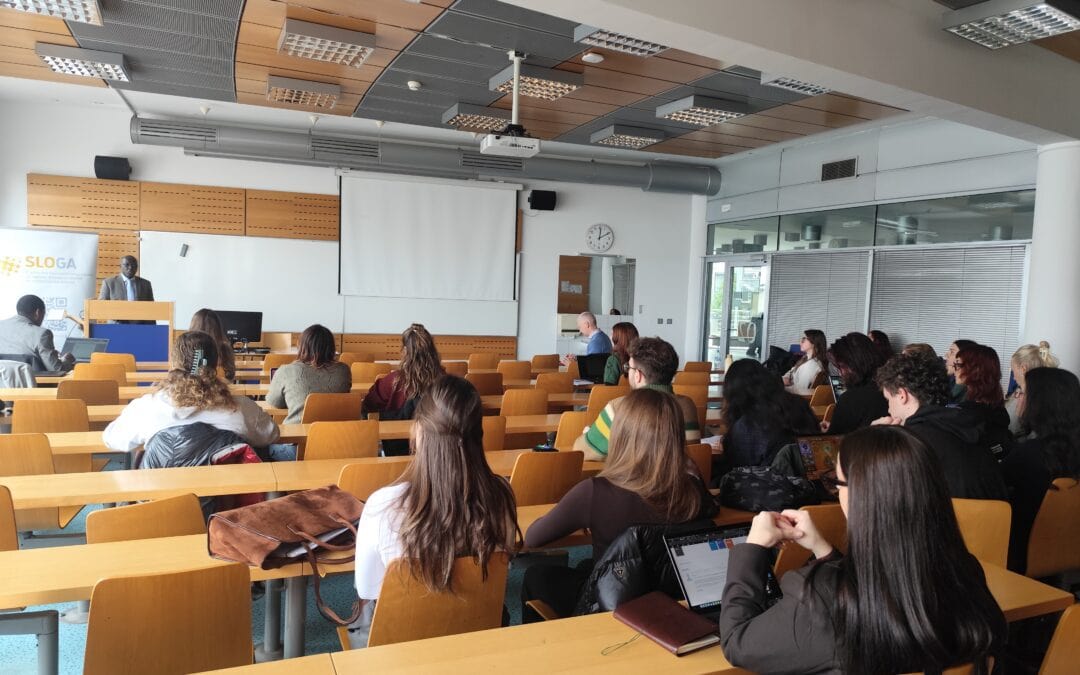
This was the central argument of Dr Moses Isooba, Executive Director of the Uganda National NGO Forum and Vice-Chair of Forus, in his address From Aid to Solidarity: What Does Genuine Global Partnership Look Like?, delivered at the University of Ljubljana’s Faculty of Social Sciences on 23 November 2026. Following a short introduction by Professor Dr Jure Požgan, Moses engaged students and academic staff in a critical examination of the power relations underpinning contemporary development cooperation. The subsequent discussion, moderated by Samar Zughool, Founder and Director of REKA.si, addressed a broad range of issues, from volunteering and engagement with local communities to the role of language in shaping development relationships.
Beyond the rhetoric of partnership
Moses argued that the fundamental problem with much of today’s international development cooperation lies in the persistent asymmetry of power between international organisations and their counterparts in the Majority World. While local organisations are increasingly entrusted with implementation, strategic decisions, financial control and the definition of development priorities frequently remain concentrated in the hands of international NGOs and donor institutions.
He captured this contradiction in two concise formulations:
“Local Implementation – Decision-Making Authority = Subcontracting.”
“Local Leadership – Resource Allocation = Abandonment.”
Both highlight a fundamental weakness in current partnership models: responsibility without authority and leadership without adequate resources cannot deliver genuine ownership.
To assess the substance of international partnerships, Moses proposed a Five-Question Partnership Audit, examining who defines priorities, controls resources, makes strategic decisions, carries financial and reputational risks, and ultimately determines success. These questions offer a practical framework for assessing whether commitments to localisation translate into meaningful changes in institutional relationships and the distribution of power.
There can be no sustainable development without sustainable societies
Placing these questions within the context of changing geopolitical and economic realities, Moses examined the growing convergence of development cooperation with trade, investment, migration and security interests. The European Union’s Global Gateway, among other initiatives, illustrates how development policy is increasingly intertwined with economic and strategic objectives.
He acknowledged that investment, trade, infrastructure and technological partnerships can contribute significantly to economic transformation. However, he cautioned against allowing these priorities to overshadow locally defined development needs and the interests of the communities concerned.
Economic growth and investment cannot, in themselves, guarantee sustainable development. Where communities are excluded from decisions affecting their lives, democratic institutions are weakened and civic space is shrinking, the foundations of long-term development are compromised.
As Moses emphasised, “There is no sustainable investment without sustainable societies.” Equally, sustainable development cannot be achieved without people having a meaningful say in decisions that affect their lives.
This perspective places democratic accountability, social cohesion and meaningful participation at the heart of development cooperation, rather than treating them as complementary concerns.
Civil society: an essential investment, not an additional cost
A particularly important dimension of Moses’s address concerned the position of civil society within the development ecosystem. He challenged the tendency of donors to prioritise short-term project financing while overlooking the institutional foundations that enable civil society to contribute to democratic governance and sustainable development.
National NGO platforms, networks and grassroots organisations are not simply intermediaries for delivering projects. They defend civic freedoms, strengthen collective advocacy, influence public policy and ensure that communities have a voice in decisions affecting them. Their contribution is particularly important in contexts where civic space is under pressure and independent civil society faces increasing financial and political constraints.
Moses therefore called for a shift away from fragmented, restricted and short-term funding towards direct, unrestricted and multi-year financing, including realistic coverage of organisational overheads and institutional development. Investing in civil society platforms and the wider ecosystem is an investment in democratic resilience, social accountability and the conditions necessary for sustainable development.
He also challenged the deficit-based understanding of local capacity that continues to influence development cooperation. Organisations in the Majority World possess extensive contextual knowledge, institutional memory, social legitimacy and community trust. These contributions constitute valuable forms of capital, even if conventional funding arrangements rarely recognise or adequately resource them. The challenge, therefore, is not simply to build local capacity, but to recognise, strengthen and resource the capacity that already exists.
From capacity building to mutual transformation
Moses identified five structural shifts required to make solidarity a reality: from consultation to shared governance; from restricted projects to quality, multi-year financing; from risk transfer to risk sharing; from capacity building to mutual transformation or capacity sharing; and from institutional preservation to more purposeful roles for international organisations.
The latter two shifts are particularly significant. Genuine localisation cannot mean that organisations in the Majority World must adapt themselves to institutional models developed elsewhere. It also requires international organisations to reconsider their own governance, incentives and understanding of expertise. Their role should increasingly be that of allies: mobilising resources, influencing their own governments, opening political spaces and amplifying locally led initiatives, rather than retaining control over development processes.
This requires a more fundamental understanding of partnership, grounded in mutual accountability, shared responsibility and recognition of different but complementary contributions.
Reimagining solidarity
The exchange with students and academic staff extended the discussion beyond institutional and policy frameworks. Questions about volunteering and engagement in local communities, as well as the language used in development cooperation, highlighted the importance of translating principles of solidarity into everyday practice and critically examining the relationships through which development work is undertaken.
Moses’s intervention offered a clear challenge to development professionals, civil society organisations and policymakers: the future of international development cooperation cannot be secured simply by changing terminology or introducing new financing instruments. It requires addressing the structural inequalities that continue to shape who decides, who controls resources and whose knowledge and priorities are valued.
The transition from aid to solidarity is ultimately a question of power. It means moving beyond relationships in which some actors define the agenda while others are expected to deliver, towards partnerships in which priorities, resources, risks and accountability are genuinely shared.
As Moses argued, genuine global solidarity requires more than offering local actors a place at someone else’s table. The table itself – its design, the agenda and the allocation of resources – must be co-created, co-owned and democratically governed.



Sorodne objave:
 MANIFEST nevladnih organizacij (NVO), ki delujejo na področju mednarodnega razvojnega sodelovanja in humanitarne pomoči (MRSHP)
 CFGC predstavitev projektov drugi sklop: Društvo za povezovanje romskih žensk Loli Luludi – Od igrišča do skupnosti: opolnomočenje mladih Rominj za globalne spremembe
 CFGC predstavitev projektov drugi sklop: Kulturno umetniško društvo Transformator – Globalni glasovi zatiranih
 Povezani za globalne spremembe: Spoznaj prejemnice sredstev 2. kroga programa Connect for Global Change!
 Se kolonializem (ne) tiče tudi nas? Serija webinarjev v okviru projekta BRIDGE
 CFGC: Crossborder event o transformativnem in presečnem pristopu do enakosti spolov